
Managing rental properties comes with its own set of challenges, especially when it comes to controlling energy costs and preventing tenant tampering with heating and cooling systems. Landlords need reliable thermostat solutions that keep utility bills in check while minimizing maintenance calls and tenant disputes.
This guide reviews the best thermostats for landlords, focusing on tamper-proof models, easy installation, and user-friendly features. Whether you manage a single rental or multiple units, you’ll find practical options to help you maintain control, reduce hassle, and ensure consistent comfort for your tenants.


Our Top 9 Best Thermostat For Landlords Picks
Whether you’re buying your first Thermostat For Landlords or replacing an old one, we compared trusted options to help you make an informed choice.
1. ControlTemp CT72 Basic Tamper Proof Thermostat
Landlords often struggle with tenants adjusting thermostats beyond reasonable limits, leading to high energy bills and system wear. A tamper-proof thermostat like this helps maintain control and prevent costly misuse.
The CT72 is designed for property owners who want a simple, reliable way to restrict temperature settings. It's ideal for rentals where consistency and minimal tenant intervention are priorities.
- Fixed 72°F limit: Prevents heat above or AC below 72°F for predictable utility costs
- Broad compatibility: Works with most boilers, furnaces, and single-stage heat pumps
- No programming required: Straightforward setup for hassle-free operation
Compared to standard programmable thermostats, the CT72 prioritizes simplicity and landlord control over customization. The main tradeoff is the lack of flexibility for tenants who may want broader temperature ranges.
- Strict tamper-proof design
- Easy to install
- No programming needed
- Works with common HVAC systems
- Reduces tenant misuse
- Fixed temperature range
- No advanced features
2. ControlTemp CT400 Advanced Tamper Proof Thermostat
For landlords seeking more control and flexibility, tamper-proof thermostats with adjustable limits and security features are essential. These models help prevent unauthorized changes while allowing owners to fine-tune settings as needed.
The CT400 stands out with its customizable set points, security code protection, and backup battery operation. It's a strong choice for property managers who want to balance tenant comfort with strict oversight.
- Adjustable set points: Landlords can set both heating and cooling limits to suit property needs
- Security code access: Only authorized users can change critical settings
- Backup battery: Maintains operation during power outages for added reliability
Unlike basic models, the CT400 offers more granular control and added security. The tradeoff is a slightly more involved setup process and no compatibility with multi-stage or electric baseboard systems.
- Customizable temperature limits
- Security code protection
- Works during power outages
- Service reminders included
- Owner website access (coming soon)
- Not for multi-stage systems
- Non-programmable
3. ControlTemp CT74 Basic Tamper Proof Thermostat
Keeping rental units comfortable without excessive energy use is a common concern for landlords. Tamper-proof thermostats with moderate temperature limits help strike a balance between tenant satisfaction and cost control.
The CT74 is ideal for owners who want to allow slightly higher temperature flexibility while still preventing extreme settings. It's a fit for properties where a 74°F cap is appropriate.
- 74°F maximum/minimum: Prevents heat above or AC below 74°F for controlled comfort
- Wide HVAC compatibility: Supports most boilers, furnaces, and single-stage heat pumps
- Simple operation: No programming required, reducing confusion for tenants
Compared to more restrictive or programmable options, the CT74 offers a middle ground. The main limitation is no support for electric baseboard or high-voltage systems.
- Moderate temperature cap
- Easy installation
- No programming needed
- Compatible with standard systems
- Fixed temperature range
- Not for high-voltage systems
4. ControlTemp CT76 Basic Tamper Proof Thermostat
Some landlords prefer to allow tenants a bit more control while still preventing excessive energy use. A tamper-proof thermostat with a higher set point can meet this need, especially in climates where comfort is a concern.
The CT76 is best for rental properties where a 76°F limit is acceptable, offering tenants more flexibility without sacrificing landlord oversight.
- 76°F set point: Allows higher heat and lower cool settings within a controlled range
- Simple, non-programmable design: Reduces user error and setup time
- Compatible with most standard HVAC: Works with boilers, furnaces, and single-stage heat pumps
Compared to stricter models, the CT76 prioritizes tenant comfort within reasonable limits. The tradeoff is less stringent energy control and no support for multi-stage or electric baseboard systems.
- Higher temperature flexibility
- Straightforward setup
- Tamper-proof design
- Works with common HVAC
- Not programmable
- Limited system compatibility
5. ControlTemp CT100 Standard Tamper Proof Thermostat

Landlords who want both tamper resistance and the ability to set schedules will appreciate programmable tamper-proof thermostats. These models help optimize comfort and savings by automating temperature changes.
The CT100 is suited for property owners who want to set a 7-day schedule while still enforcing upper and lower limits. It's a good fit for rentals with predictable occupancy patterns.
- 7-day programmable: Allows automated temperature changes for each day
- Tamper-proof limits: Prevents heat above 72°F and cool below 75°F
- Multi-system compatibility: Supports single and multi-stage boilers, furnaces, and heat pumps
Compared to basic tamper-proof options, the CT100 adds scheduling flexibility. The tradeoff is a slightly more complex setup and a fixed temperature range.
- Programmable scheduling
- Tamper-proof limits
- Works with multi-stage systems
- Suitable for various HVAC types
- Fixed temperature caps
- Setup may be more involved
6. Suuwer Non-Programmable Digital Thermostat Blue

For those who prioritize clear visibility and straightforward operation, the Suuwer Non-Programmable Digital Thermostat offers a large, blue backlit display. Many users, especially seniors, want a thermostat that's easy to read and operate without complex menus.
This model is best for anyone seeking a simple, reliable thermostat for single-stage systems, especially where visibility is a concern. It's powered by batteries or 24VAC, making it flexible for homes without a C wire.
- Large blue backlit display: Enhances readability for all ages
- Dual power options: Runs on batteries or 24VAC without a C wire
- Accurate temperature control: Maintains consistent comfort
Compared to programmable or smart thermostats, the Suuwer model focuses on simplicity and visibility. The tradeoff is the lack of scheduling or remote features.
- Very clear display
- Simple operation
- Dual power options
- Accurate temperature control
- Good for seniors
- No scheduling features
- Not for multistage systems
7. Emerson Sensi Smart Programmable Thermostat
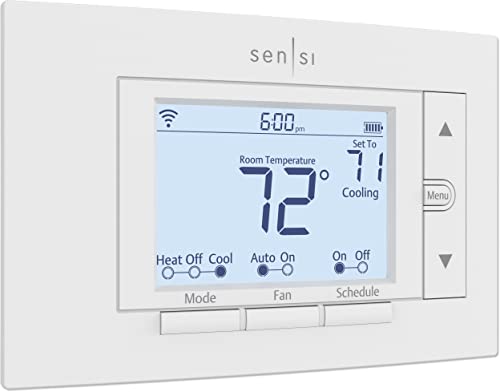
Landlords looking to upgrade from standard thermostats often want a familiar look and feel, but with added smart features. A model that fits the same space and offers app-based control can ease the transition.
The Emerson Sensi Smart Thermostat is ideal for those who want programmable schedules, remote access, and easy DIY installation without changing the wall footprint.
- Traditional design: Fits in place of most old thermostats for a seamless update
- Smart features: App control, usage reports, and maintenance alerts
- Flexible installation: No c-wire required in most cases
Compared to tamper-proof models, the Sensi offers more features and remote management but less direct restriction of tenant adjustments. The tradeoff is a higher learning curve for some users.
- App-based control
- Easy DIY installation
- Fits traditional spaces
- Energy-saving scheduling
- Maintenance alerts
- Not tamper-proof
- Requires app setup
8. Honeywell Home RTH7600D 7-Day Touchscreen Thermostat

For those who want to automate their home's climate control without relying on Wi-Fi or smart features, the Honeywell Home RTH7600D offers robust weekly scheduling. Many users prefer a programmable thermostat that doesn't require a C wire or app connectivity.
This model is best for users who want to set it and forget it, with up to four programmable periods per day and a large, easy-to-read touchscreen. It's especially suitable for families with predictable routines.
- 7-day scheduling: Customize temperature settings for each day of the week
- Large touchscreen: Easy to view and adjust settings
- Smart Response Technology: Learns how long it takes to reach set temperatures
Compared to smart thermostats, this Honeywell model focuses on reliable, programmable control without app integration. The tradeoff is the lack of remote or voice control features.
- Full 7-day scheduling
- Large touchscreen display
- Easy to install
- Smart Response Technology
- Works with many system types
- No remote control
- No smart home features
9. Honeywell Pro 1000 Vertical Non-Programmable Thermostat

Some landlords prefer the reliability of a basic, non-programmable thermostat that tenants can adjust within a limited range. Simplicity and durability are key for minimizing maintenance and confusion.
The Honeywell Pro 1000 is a straightforward, vertical thermostat ideal for properties where manual control is sufficient and tamper resistance is not required.
- Simple manual operation: No programming or complex menus
- Compact vertical design: Fits small spaces and blends with most decor
- Reliable build: Trusted Honeywell quality for long-term use
Compared to programmable or tamper-proof models, the Pro 1000 offers ease of use and low maintenance. The tradeoff is no scheduling or restriction features.
- Very simple operation
- Compact design
- Reliable brand
- Easy to install
- Not tamper-proof
- No scheduling options
Buying Guide: How to Choose the Best Thermostat for Landlords
Thermostats for rental properties come in a range of types, from basic manual units to advanced tamper-proof models. Choosing the right one means balancing tenant comfort, energy efficiency, and the level of control you need as a landlord. Many buyers assume all thermostats are interchangeable, but compatibility, feature sets, and security vary widely.
- Tamper-proof vs. standard models: Some thermostats lock out tenants from changing settings, while others allow full access
- Programmable vs. non-programmable: Programmable models automate temperature changes, while non-programmable units require manual adjustment
- Display readability: Larger, backlit displays are easier for all users, especially in properties with older tenants
- System compatibility: Not all thermostats work with every HVAC system (check for single-stage, multi-stage, heat pump, or electric baseboard compatibility)
- Power options: Some models use batteries, others require a common wire (c-wire), and some offer both
- Security features: Tamper-proof units may use fixed limits or customizable codes for landlord-only access
- Tradeoffs: More control often means less flexibility for tenants; advanced features can add complexity
- Common misunderstandings: Many assume any thermostat will work with any system, or that tamper-proof means programmable scheduling
Choosing Between Tamper-Proof and Standard Thermostats
Landlords must decide how much control to retain over temperature settings. Tamper-proof thermostats prevent tenants from making costly adjustments, while standard models offer more flexibility but less oversight.
- Tamper-proof models: Best for controlling energy costs and preventing misuse
- Standard models: Suitable for trusted tenants or owner-occupied units
Importance of Display Size and Readability
A clear, easy-to-read display reduces confusion and maintenance calls. This is especially important in properties with older residents or frequent tenant turnover.
- Large, backlit screens: Help all users see settings clearly
- Simple interfaces: Minimize user errors and support quick troubleshooting
Compatibility with HVAC Systems
Not all thermostats fit every heating and cooling setup. It's crucial to match the thermostat to your system type to avoid installation headaches.
- Single-stage vs. multi-stage: Check if your property uses a basic or advanced HVAC system
- Heat pump support: Some models are designed for heat pumps, others are not
- Electric baseboard compatibility: Many tamper-proof models do not support high-voltage systems
Scheduling and Automation Needs
Programmable thermostats can save energy by automating temperature changes, but not all tamper-proof models offer this feature. Decide if scheduling is a priority or if fixed limits are more important.
- Programmable models: Allow for set-and-forget temperature changes
- Non-programmable models: Simpler, but require manual adjustments
Security and Access Control
If preventing unauthorized changes is critical, look for thermostats with security codes or fixed set points. These features help landlords maintain control and avoid disputes.
- Security codes: Only landlords can adjust critical settings
- Fixed limits: Tenants cannot exceed preset temperature ranges
Final Buying Advice
Selecting the right thermostat for your rental property depends on your priorities—control, ease of use, and compatibility. Avoid overbuying features you don't need, but don't underbuy if security is a concern.
- Match thermostat type to your HVAC system before purchasing
- Choose tamper-proof models if you need strict control over settings
- Opt for large, clear displays in properties with older tenants
- Consider programmable options for automated energy savings
- Don't assume all thermostats are interchangeable—check compatibility and features carefully
FAQ For Thermostat For Landlords
1. What is a tamper-proof thermostat and why do landlords use them?
2. How do I know if a thermostat is compatible with my rental property's HVAC system?
3. Can tenants override tamper-proof thermostats?
4. Are programmable thermostats better for rentals?
5. Do I need a c-wire to install these thermostats?
6. What should I do if my tenant reports the thermostat isn't working?
Related Posts
- Best Heavy Duty Dolly: Top 8 Picks
- Best Smartlock For Airbnb
- Best Taser For Women S Protection
- Best Budget Multi Process Welder
- Best Filler For 3d Prints
- Best Caulk For Toilet Base: Top 10 Picks
- Best Finish For Outdoor Wood Table
- Best Glue To Bond Metal: Top 8 Picks
- Best Superglue For Plastic: Top 6 Picks
- Top 10 Best Tactical Flashlight For Self Defense
- Best Battery Operated Closet Light: Top 10 Picks
- Best Construction Work Gloves
- Top 9 Best Height For Work Bench
- Best Tub Shower Conversion Costs Options Newark Oh: Top 9 Picks
- Best Sandpaper For Paint Removal: Top 10 Picks
- Top 7 Best Adhesive For Pvc
- Best Single Mode Flashlight
- Best Ventless Garage Heater
- Best Heat Pump Resistance Heating Which Is More Efficient Your: Top 6 Picks
- Top 6 Best Glue For Foam Insulation Board