
Choosing the right mini CNC machine can be overwhelming, especially with so many options promising precision and versatility. Home users and hobbyists often struggle to find a model that balances ease of use, safety, and the ability to handle a range of materials without requiring industrial expertise.
This guide reviews the best mini CNC machines available, highlighting what each one does best. Whether you’re a beginner looking for a simple setup or a maker seeking advanced features, you’ll find clear comparisons, practical pros and cons, and advice to help you select the right CNC router for your needs.

Top 5 Best Mini Cnc Machine
By examining product features, customer reviews, and real-world usage, we compared leading Best Mini Cnc Machine products and selected our top picks.
1. Genmitsu CNC 3018-PRO Router Kit
For many home users, the biggest barrier to starting with CNC woodworking is the complexity of assembly and setup. Machines that are difficult to put together can be discouraging and delay creative projects.
The Genmitsu CNC 3018-PRO is ideal for beginners who want a straightforward, reliable entry into CNC routing. Its upgraded design reduces assembly steps and improves stability, making it a hassle-free choice for first-time users.
- Pre-positioned components: Simplifies assembly and increases working accuracy.
- Raised base height: Improves overall stability for better results on various materials.
- GRBL open-source software: Ensures broad compatibility and easy access to support resources.
Compared to more complex kits, the 3018-PRO focuses on simplicity and user-friendliness. The tradeoff is a smaller workspace and spindle compared to advanced or upgradeable models.
- Very easy to assemble
- Stable base design
- Good for beginners
- Wide material compatibility
- Includes software support
- Limited work area
- Not for heavy-duty tasks
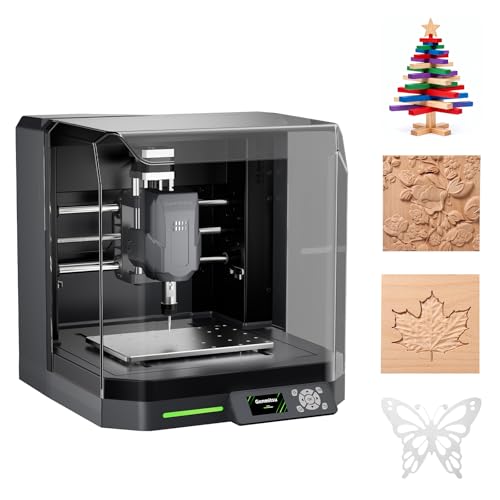
2. Genmitsu Cubiko CNC Router Enclosed
For small businesses seeking a hassle-free start, plug-and-play CNC machines eliminate the intimidation of assembly and calibration. Ready-to-use models help users focus on production and creativity rather than setup.
The Genmitsu Cubiko CNC Router arrives fully assembled, with an enclosed design for safety and dust control. Its automatic tool height adjustment and smart surface sensing make it especially appealing for beginners and those prioritizing a clean, quiet workspace.
- No assembly required: Ready to use out of the box for immediate operation
- Automatic tool and surface adjustment: Simplifies setup and improves accuracy
- Safety enclosure with auto-stop: Protects users and keeps debris contained
Compared to open-frame or DIY kits, the Cubiko prioritizes convenience and safety. The tradeoff is a smaller depth per pass and limited manual customization.
- Fully assembled
- Automatic adjustments
- Enclosed for safety
- Beginner-friendly tutorials
- Quiet operation
- Limited depth per pass
- Less manual customization
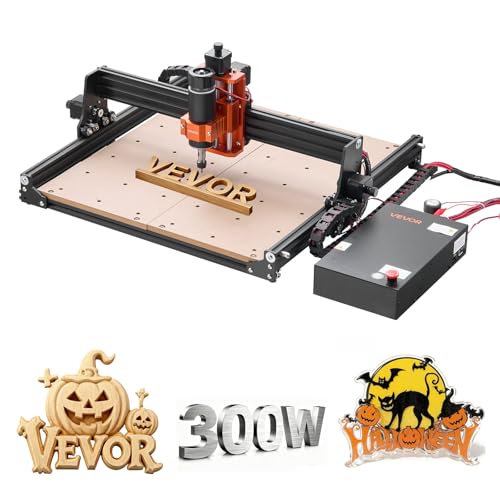
3. VEVOR CNC Router 300W 3-Axis Large Area
For those tackling bigger projects or needing more creative space, a limited work area can be frustrating. The VEVOR CNC Router 300W addresses this by offering a generous workspace, making it ideal for larger pieces and more ambitious designs.
This router combines a powerful spindle with a sturdy frame, supporting a wide range of materials and providing stability even during extended use. It’s a strong choice for users who want room to experiment and value durability.
- Expansive work area: 15.75 x 15.75 inches accommodates larger projects and materials
- 300W spindle power: Delivers smooth engraving on wood, acrylic, foam, and soft metals
- Touchscreen offline controller: Enables computer-free operation for flexible use
Compared to more compact models, this VEVOR router prioritizes workspace and power. The tradeoff is a larger footprint, which may not suit those with limited bench space.
- Large work area
- Powerful 300W spindle
- Stable aluminum alloy body
- Touchscreen offline control
- Pre-assembled components
- Takes up more space
- Not suited for very hard metals
4. MAKERA CARVERA Air Desktop CNC Machine
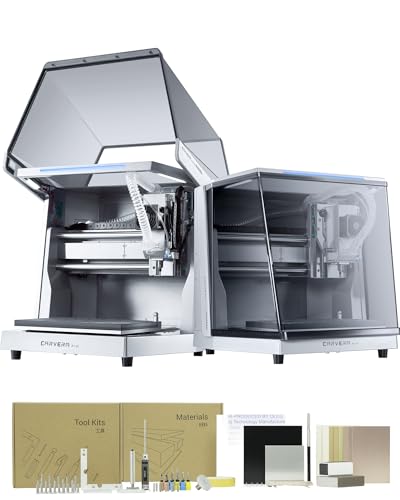
Switching tools mid-project can slow down workflow and introduce errors. The MAKERA CARVERA Air solves this with a rapid tool-changing system, making it ideal for intricate or multi-step jobs where efficiency matters.
This compact, enclosed CNC machine is designed for hobbyists and small workshops that need precision and versatility in a small footprint. Its automation features and cross-platform software support make it accessible for a wide range of users.
- Quick tool change system: Swap tools in just 10 seconds to streamline complex jobs
- Auto-probing and leveling: Ensures accurate cuts on uneven materials for professional results
- Compact, enclosed design: Fits easily in small spaces while reducing noise and dust
Compared to open-frame routers, the CARVERA Air prioritizes workflow efficiency and precision. The main tradeoff is a smaller work area, which may limit very large projects.
- Fast tool changes
- Automated calibration
- Enclosed for safety and cleanliness
- WiFi and USB connectivity
- Supports optional 4th axis
- Smaller workspace
- Premium price point
5. RATTMMOTOR Upgrade 3018-PRO CNC Kit

Safety is a top concern for many home users, especially when working with moving parts and sharp tools. The RATTMMOTOR Upgrade 3018-PRO CNC Kit addresses this with enhanced safety features, making it a reassuring choice for beginners and cautious users.
This machine includes an emergency stop button and axis limit switches, along with detailed instructions and videos for easy assembly. It’s best for those who want extra safeguards and clear guidance as they learn CNC basics.
- Emergency stop button: Instantly halts operation in case of issues
- Axis limit switches: Prevents over-travel for safer operation
- Detailed assembly support: Step-by-step instructions and videos for beginners
Compared to other entry-level kits, this model prioritizes safety and user guidance. The tradeoff is a more basic frame and limited support for harder materials.
- Enhanced safety controls
- Clear assembly instructions
- Lightweight but durable frame
- Supports offline control
- Suitable for various soft materials
- Not for hard metals
- Basic design aesthetics
Buying Guide: How to Choose the Best Mini CNC Machine
Mini CNC machines are technically advanced tools designed for precision carving, milling, and engraving on a variety of materials. Buyers often face tradeoffs between workspace size, ease of assembly, safety features, and upgrade potential. Many first-time users misunderstand the differences between plug-and-play models and kits requiring assembly, or overestimate the machine's ability to handle hard metals without upgrades.
- Plug-and-play vs. DIY kits: Some models arrive fully assembled and ready to use, while others require significant setup and calibration.
- Workspace size: Larger work areas allow for bigger projects but require more space; compact models fit smaller benches but limit project size.
- Material compatibility: Not all machines can handle metals; most are optimized for wood, plastics, and soft materials unless upgraded.
- Safety features: Emergency stop buttons, enclosures, and limit switches add peace of mind, especially for beginners.
- Upgrade potential: Some routers support extensions, laser modules, or higher-powered spindles, while others are fixed in capability.
- Offline operation: Machines with offline controllers or SD card support can run without a computer, offering more flexibility.
- Ease of assembly and use: Pre-assembled or clearly guided kits reduce frustration for new users.
- Common misunderstandings: Many buyers assume all mini CNCs can cut hard metals or are equally easy to set up—this is rarely the case.
Choosing Between Plug-and-Play and DIY Kits
Plug-and-play CNC machines are ideal for those who want to start carving immediately with minimal setup. DIY kits, on the other hand, offer a learning experience and often a lower price, but require careful assembly and calibration. Consider your comfort with tools and instructions before choosing.
- Plug-and-play models: No assembly, immediate use, higher cost
- DIY kits: Assembly required, more affordable, greater learning curve
Workspace Size and Project Ambitions
The size of the machine's work area directly affects the scale of projects you can tackle. Larger workspaces are better for signs, panels, or multi-part projects, while compact models are best for small crafts and prototypes.
- Large work area: More creative freedom, but needs more space
- Compact machines: Fit small benches, ideal for hobbyists with limited room
Safety and Ease of Use
Safety features like emergency stop buttons, limit switches, and enclosures are especially important for beginners or shared spaces. Machines with clear instructions and support resources also reduce the intimidation factor for new users.
- Emergency stop and limit switches: Prevent accidents and over-travel
- Enclosures: Contain dust and improve safety
- Detailed guides: Make setup and operation less stressful
Upgrade and Expansion Options
Some mini CNC machines are designed to grow with your skills, supporting laser modules, rotary axes, or more powerful spindles. Others are fixed in their capabilities. Think about whether you want a machine that can evolve with your needs.
- Expandable models: Support add-ons for new functions
- Fixed models: Simpler, but limited in future upgrades
Offline Operation and Connectivity
If you prefer not to keep a computer tethered to your CNC, look for models with offline controllers or SD card support. This adds flexibility, especially in workshops with limited computer access.
Final Buying Advice
Choosing the right mini CNC machine comes down to matching your project goals, workspace, and comfort with assembly. Avoid overbuying features you won't use, but don't underbuy if you plan to grow your skills.
- Assess your workspace and project size before choosing
- Prioritize safety features if you're new to CNC
- Consider future upgrade potential if you plan to expand your capabilities
- Look for clear assembly instructions or plug-and-play models if you want a smooth start
- Offline operation is valuable if you need flexibility in your setup
FAQ For Best Mini Cnc Machine
1. What materials can mini CNC machines handle?
2. Do I need to assemble my mini CNC machine?
3. Can I use a mini CNC machine without a computer?
4. Are mini CNC machines safe for beginners?
5. How important is the work area size?
6. Can I upgrade my mini CNC machine later?
7. What software is needed for mini CNC machines?
Related Posts
- Best Construction Ear Protection: Top 6 Picks
- Best Shade For Mig Welding
- Top 10 Best Weed Eater Head For Stihl
- Best Paint For Chassis: Top 6 Picks
- Top 9 Best Light For Pistol
- Best Mini Skid Steer For Landscaping: Top 6 Picks
- Top 6 Best Screws For Floating Shelves
- Top 6 Best Gravel For French Drain
- Best Bonding Primer For Oil Based Paint
- Top 7 Best 3 Ton Mini Split
- Best Beginner Soldering Iron
- Top 6 Best Pressure Washer Hose For Car Detailing
- Best Tool For Hanging Pictures: Top 9 Picks
- Top 5 Best Magnetic Welding Ground Clamp
- Best Brush To Use With Polyurethane
- Top 5 Best Spray Paint For Bikes
- Best Nail Gun For Flooring: Top 9 Picks
- Best Glue For Aluminium To Aluminium: Top 6 Picks
- Best Hand Truck Dolly: Top 9 Picks
- Top 10 Best Glue For Engineered Wood Flooring